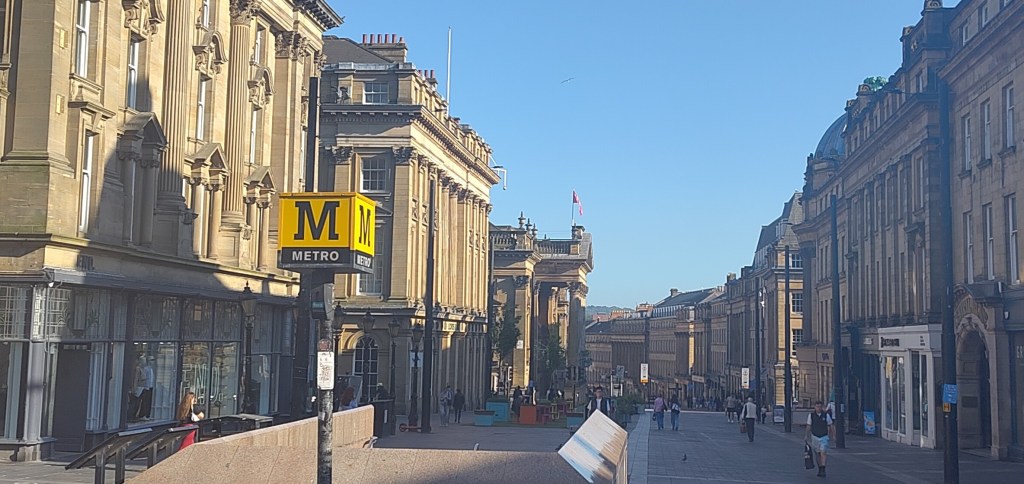
Newcastle’s biggest problem is the economic system that we live under.
Most people agree that what we have isn’t working, although they might not be as anti-capitalism as me. Many want to go back to a better, fairer, safer system, which is what they thought they’d get from a Labour government, and is what’s promised by the Lib Dems and the Greens. Others have bought the lie that immigration is the problem.
Newcastle, like other industrial cities, has been hit particularly hard by the changes of the last 45 years. It has never recovered from the loss of heavy industry and the skilled jobs it provided, although there have been multiple efforts to replace them.
More recently the retail and hospitality sector has come under pressure from a combination of lower disposable incomes and changing habits as people move to online shopping and socialising at home.
Newcastle doesn’t have enough decent, affordable homes. There were 8,471 people on the council housing register in September 2025; a 52% increase in the last two years and the average rent for a two-bedroom home in Newcastle is now almost £1,200 per month.
(This is another by-product of our economic system. The sell-off of council housing under right to buy and the restrictions that reduced councils’ abilities to replace them is a major factor in the UK housing problem.)
Newcastle’s difficult situation was made significantly worse by austerity.
Since 2010 Newcastle City Council has lost FIGURE in funding. Cuts at this level make it impossible to maintain the kinds of services the city needs.
Additional government money is tied to specific pots and projects that are government priorities. So the council can’t spend it in the way that would be most beneficial for the city. (I don’t think anybody in Newcastle would have put the lighting poles on Northumberland Street top of their priorities list.)
Government money is often only available to ‘unlock’ private sector investment so our money subsidises private profit instead of improving our community. Investors want a return on their investment and that money goes out of the city: whether it’s the rents paid for student accommodation and private rentals or for offices and retail spaces.
Newcastle is poor. Almost 1 in 4 children in Newcastle now live in poverty – a 10 per cent increase since 2014.
We have a drug and alcohol problem. There are people high on drugs on Northumberland Street; gangs of young people riding around the city delivering drugs; and people throughout Newcastle living lives blighted by drugs and alcohol dependence.
Newcastle is not healthy. Life expectancy is below the national average and there is health inequality.
Like many cities, Newcastle has a lot of rubbish to manage: from residents and from businesses plus thousands of tonnes of street litter and a huge problem with fly-tipping. Finding ways to deal with that waste is challenging and there are valid concerns about the new regional incinerator planned for Teesside. Funding cuts have also meant that less money is spent on cleaning the city.
NUFC fan loyalty is exploited by its owners. NUFC means a lot to a lot of people in Newcastle. Sadly, some people see that loyalty as a business opportunity.
If this was just about the relationship between the owners and the fans, that would be one thing. But the desire for investment and a reluctance by some politicians to risk alienating fans, gives the owners influence over how the city develops and, if the rumours are true, one of our parks: super stadiums are designed to get every bit of fan spend for the club, they don’t benefit the local economy. https://www.theguardian.com/sport/2025/apr/29/football-soccer-stadiums-everton-nfl It’s also made Newcastle part of the Saudi regime’s sportswashing campaign – a shameful situation for our city.
There’s too much traffic. This is a challenge for all cities but Newcastle also has to deal with traffic cutting through on its way to other parts of the region.
The Climate Emergency is taking its toll here too: storms, heavy rain and other extreme weather events are much more frequent. They damage our infrastructure and makes everyday life harder.
Newcastle and the wider North East has a – justified – reputation for friendliness, generosity and tolerance. But there’s an ugly side too. The North East has the highest rates of domestic violence in England. We also have racism. Not all – or even most – of us but enough of us that it’s been easy to convince many people that the problems we are experiencing are due to refugees and migrants. We’ve had weekly racist demonstrations in Newcastle city centre for eight months justified by the toxic narrative that it’s refugees in particular who threaten the safety of women and girls, and not the male violence that is present in every community.
 Jane For Monument